

Navigating Modern Academia: Balancing Writing Efficiency with Quality Control
The transition into higher education is often defined by a sharp increase in volume—more reading, more complex ideas, and, most significantly, a relentless stream of written assignments. For undergraduate students today, the challenge isn’t just about understanding the subject matter; it is about managing the sheer velocity of deadlines without letting the quality of their work slip. In an era where information is available at the click of a button, the real skill lies in synthesizing that information into a coherent, persuasive, and original argument. Balancing these two pillars—efficiency and quality—is the hallmark of a successful academic career.
The pressure to produce high-quality work quickly often leads to a “rush-and-submit” culture, which can be detrimental to long-term learning and grades. This is where professional support systems become invaluable. For many students, utilizing a professional essay editing service through Myassignmenthelp provides the necessary safety net, ensuring that even when a draft is completed in a time-crunch, the final submission meets the rigorous standards of university examiners. By integrating expert feedback into the writing process, students can maintain a high pace of output while simultaneously improving their own writing style through the corrections provided.
The Pillars of Academic Writing Efficiency
Efficiency in writing is not about typing faster; it’s about reducing the “friction” between your thoughts and the page. Most students waste time because they treat writing as a single, massive task rather than a series of smaller, manageable steps.
1. The Pre-Writing Phase: Research and Mapping
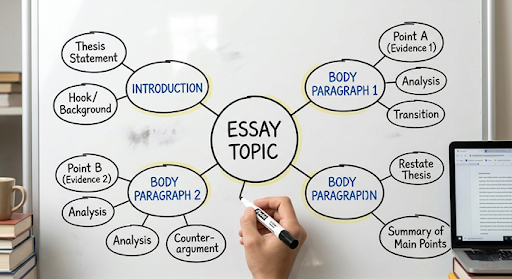
Before you type a single word of your introduction, you must have a roadmap. Spending thirty minutes on a detailed outline can save three hours of “writer’s block” later.
- Identify the Core Argument: What is the one thing you want the reader to take away?
- Source Categorization: Group your research by themes rather than by author. This makes it easier to build paragraphs that compare different viewpoints.
2. The “Draft Now, Polish Later” Rule
One of the biggest hurdles to efficiency is the “internal editor”—that voice in your head that makes you delete a sentence the moment you write it. To be efficient, you must separate the act of creation from the act of criticism. Write your first draft with the goal of getting your ideas down, no matter how messy they are. You cannot edit a blank page.
Maintaining Quality Control
While efficiency gets the job done, quality gets the grade. Quality control in academia involves three specific layers: logical flow, evidence-basis, and technical precision.
Logical Flow and Structure
A high-quality essay should feel like a guided tour through an idea. Each paragraph should act as a stepping stone to the next. If you find yourself jumping between unrelated points, your quality is slipping. Use “Signposting” language—words like furthermore, conversely, and consequently—to tell the reader exactly where your argument is going.
The Evidence-Basis
In undergraduate studies, your opinion only matters if it is backed by data or peer-reviewed literature. A common mistake is “cherry-picking” evidence. True quality control involves acknowledging counter-arguments and explaining why your position remains valid despite them. This demonstrates critical thinking, which is the highest tier of the marking rubric.
Strategic Comparison: Efficiency vs. Quality
To better understand how to balance these two, let’s look at the different approaches students take:
| Feature | The “Efficiency-Only” Approach | The “Quality-Only” Approach | The Balanced Approach |
| Research Time | Minimal; uses the first 3 links found. | Excessive; reads every book in the library. | Targeted; uses 5-7 high-quality sources. |
| Drafting Speed | Very Fast; focuses on word count. | Very Slow; obsesses over every word. | Steady; uses a structured outline. |
| Editing | Skim-reads once for typos. | Edits continuously while writing. | Professional review and structural checks. |
| Result | Met the deadline, but low grade. | High grade, but missed other deadlines. | High grade and managed workload. |
The Role of Academic Support Services
Modern education is competitive, and the expectations for “Perfect English” and “Standardized Formatting” are higher than ever. It is important to recognize when you need a helping hand. Professional assignment and essay writing services have become a staple for students who are balancing work, family, and multiple courses. These services don’t just provide a document; they provide a template for how a high-distinction paper should look, feel, and be structured.
Using these resources ethically means using them as a learning tool. By reviewing a professionally written assignment, a student can learn how to properly cite obscure sources, how to structure a complex literature review, and how to maintain an academic tone that is neither too casual nor too dense.
Practical Steps for Global Students
Regardless of whether you are studying in London, New York, Sydney, or Toronto, the core requirements of a good essay remain the same. Here is a universal checklist to keep your work on track:
- Decode the Rubric: Every assignment comes with a marking guide. If the rubric says “20% for citations,” spend 20% of your time ensuring your bibliography is flawless.
- Use Digital Tools Wisely: Use reference managers like Zotero or Mendeley to automate your citations. This is a massive efficiency boost that also increases quality by removing human error.
- The “Read Aloud” Test: Before submitting, read your essay out loud. If you run out of breath during a sentence, that sentence is too long. If a paragraph sounds confusing to your ears, it will be confusing to the professor’s eyes.
- Reverse Outlining: After finishing your draft, write a one-sentence summary of each paragraph. If the summaries don’t follow a logical order, you need to rearrange your paragraphs.
Conclusion: The Sustainable Student
The goal of balancing writing efficiency with quality control isn’t just about getting an “A.” It’s about building a sustainable workflow that prevents burnout. Academia is a marathon, not a sprint. By utilizing the right strategies—outlining, separating drafting from editing, and knowing when to use professional support like Myassignmenthelp—you can navigate your undergraduate years with confidence and clarity.
Remember, the best writers aren’t those who never struggle; they are the ones who have developed a system to overcome those struggles efficiently.
Frequently Asked Questions (FAQ)
How can I improve my writing speed without making mistakes?
Ans: The secret is the pre-writing phase. If your outline is detailed enough, the writing process becomes a simple task of “filling in the blanks” rather than figuring out what to say. This prevents the “stop-start” pattern that leads to errors.
Is using an editing service considered cheating?
Ans: No. Professional editing is a standard part of all professional writing, from journalism to academic journals. Using a service to check your grammar, flow, and formatting is a proactive way to ensure your work meets professional standards.
What is the most common reason students lose marks?
Ans: Most marks are lost due to poor structure and failing to answer the specific question asked in the prompt. Students often get so caught up in the research that they forget to link their points back to the main thesis.
How do I maintain a “global tone” in my writing?
Ans: Avoid regional slang and overly complex “academic-sounding” words. Aim for clarity and precision. A global tone is one that can be easily understood by an English speaker in any part of the world, focusing on standard grammar and logical progression.
About The Author
I am Lucy Wilson, a Senior Academic Consultant at Myassignmenthelp, where I specialize in helping university students navigate the complexities of higher education. With over a decade of experience in content strategy and academic support, I am passionate about bridging the gap between student effort and high-distinction results. For more details, Click here