
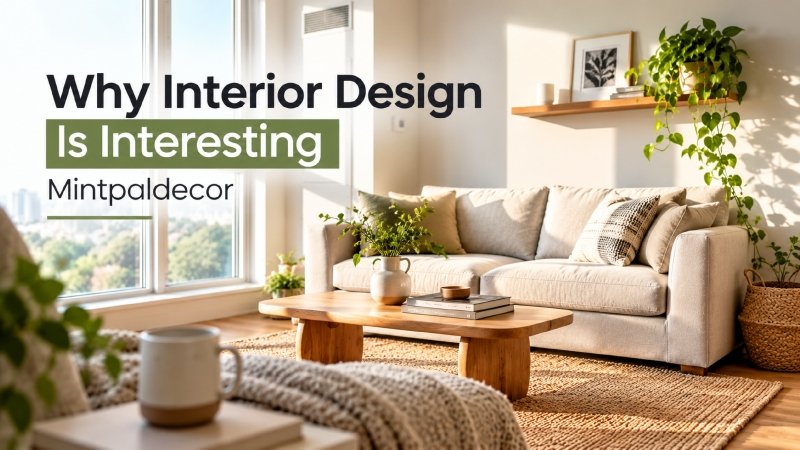
Walk into two rooms with the same furniture, and one can feel calm while the other feels chaotic. That invisible difference is exactly why interior design is interesting — Mintpaldecor treats it not as decoration, but as a living conversation between people and the spaces they occupy. Interior design sits at the crossroads of art, psychology, architecture, and human behavior. It asks a deceptively simple question: how should a space make you feel, and what must change to get you there? Few professions let you touch color theory, ergonomics, cultural history, and emotional wellbeing before lunch. In this article, you will discover why interior design is important, what makes the field endlessly fascinating, and how its principles quietly shape your daily life — whether you notice them or not. Why Interior Design Is Interesting Mintpaldecor?
Quick Answer
Interior design is interesting because it merges creativity with human psychology — every choice of color, layout, and light directly influences mood, focus, and comfort. Mintpaldecor highlights that a well-designed space is not just beautiful; it actively improves how people live, work, and connect with each other daily.
Quick Facts: Interior Design at a Glance
| Aspect | What It Means | Why It Matters |
| Core idea | Shaping interiors for function + feeling | Spaces affect behavior |
| Key disciplines | Color, light, layout, materials | Each element shifts mood |
| Primary benefit | Comfort, focus, emotional balance | Better daily living |
| Who it serves | Homeowners, renters, businesses | Everyone uses interiors |
| Mintpaldecor view | Design as daily-life problem-solving | Beauty with purpose |
Why Interior Design Is Important Beyond Aesthetics
Interior design is important because the built environment directly influences stress levels, productivity, sleep quality, and social connection — outcomes that official public health guidelines on housing and wellbeing repeatedly emphasize. A room is never neutral. Poor lighting strains the eyes and flattens energy. Cluttered layouts raise cognitive load, making simple tasks feel heavier. In contrast, a thoughtfully arranged space lowers friction in your routines: the coffee station sits where you actually make coffee, the reading chair catches the morning sun, and walkways stay clear so movement feels effortless. This is the most important and practical part of the field.
Good design removes tiny daily frustrations you never consciously registered, and that invisible service is precisely why interior design is important in both homes and workplaces.
What Makes Interior Design Interesting: The Psychology Layer
What makes interior design interesting is that it is applied psychology disguised as furniture and paint. Color psychology in interior design demonstrates this clearly: warm terracotta tones tend to energize social spaces, while muted blues and greens support rest and concentration. Designers read rooms the way psychologists read people — asking what emotion a space should host before choosing a single object. Ceiling height changes how freely people think; soft textures invite touch and lingering; symmetrical arrangements calm the eye. Every decision carries an emotional consequence, which turns each project into a live experiment about human nature. You’re doing more than simply organizing a room. You are quietly engineering the feelings of everyone who enters it, and that responsibility keeps the craft permanently fresh.
Interior Design and Human Emotions: Rooms That Talk Back
Interior design and human emotions are linked through memory, sensory input, and personal identity. A kitchen painted the same yellow as a grandparent’s home can trigger warmth before a meal is even cooked. Designers call this emotional anchoring — using familiar materials, scents, and palettes to make a space feel safe and personal. This is why two people can react differently to an identical room: interiors carry cultural and autobiographical meaning. Mintpaldecor approaches this layer with curiosity rather than formulas, asking clients what moments they want a room to hold. The result is a space that functions like a mirror, reflecting the occupant’s story back at them. Few creative fields offer that kind of intimate, daily dialogue with the people you design for.
How Each Design Element Shapes Daily Experience
| Element | Psychological Effect | Practical Example |
| Color | Sets emotional temperature | Blue bedroom for deeper rest |
| Lighting | Regulates energy and focus | Layered task + ambient light |
| Layout | Controls flow and stress | Clear paths, zoned activities |
| Texture | Adds comfort and depth | Linen, wood, and wool layering |
| Scale | Affects calm vs. overwhelm | Right-sized furniture per room |
Space Planning and Furniture Arrangement: The Silent Logic
Space planning and furniture arrangement form the engineering side of interior design — the part most people never see but always feel. A skilled designer maps circulation paths, conversation zones, and sightlines before a single purchase happens. The logic is measurable: seating angled toward each other encourages dialogue; a sofa blocking a natural walkway creates subconscious tension every time someone squeezes past it. Small-space planning is where the discipline becomes genuinely thrilling, because constraints force invention. A narrow apartment demands multi-functional pieces, vertical storage, and visual tricks like mirrors and low-profile furniture. Solving that puzzle — making 40 square meters live like 60 — delivers the same satisfaction as cracking a difficult equation, except the answer is a home someone loves waking up in. Why Interior Design Is Interesting Mintpaldecor.
Interior Design Creativity and Innovation: A Field That Never Sits Still
Interior design creativity and innovation thrive because the field reinvents itself with every cultural shift, material breakthrough, and lifestyle change. Remote work rewrote what a home office must do. Sustainable materials pushed designers toward bamboo, reclaimed wood, and low-impact finishes. Compact urban living spawned transformable furniture that folds, stacks, and disappears. Designers today borrow from biophilic principles — weaving natural light, plants, and organic shapes indoors — because research consistently links nature exposure to reduced stress. This constant evolution means no two projects, clients, or decades look alike. For a curious mind, interior design offers an endless stream of new problems: each home is a fresh brief, each budget a creative constraint, and each solution a small original invention that improves someone’s everyday life.
Modern Home Interior Aesthetics: Why Beauty Is Functional
Modern home interior aesthetics favor clean lines, honest materials, and breathing room — but the real reason this style endures is functional, not fashionable. Visual clutter competes for attention; simplified spaces return that attention to the people and activities inside them. Open shelving forces mindful ownership. Neutral foundations let one bold piece — a painting, a vintage chair — carry personality without noise. Mintpaldecor frames modern aesthetics as editing rather than emptiness: keep what serves you, remove what distracts, and let light and proportion do the heavy lifting. The interesting twist is that restraint demands more skill than abundance. Choosing three perfect objects is harder than buying thirty decent ones. That discipline — beauty achieved through deliberate subtraction — is where modern design becomes a genuine craft worth studying.
Practical Checklist: Reading Any Room Like a Designer
| Step | Action | Quick Win |
| 1 | Identify the room’s main emotion | Name the feeling you want first |
| 2 | Audit natural light | Place key activities near windows |
| 3 | Map walkways | Keep paths clear and logical |
| 4 | Fix the color base | Calm tones for rest, warm for social |
| 5 | Edit before adding | Remove one item before buying one |
| 6 | Layer lighting | Combine ambient, task, and accent |
| 7 | Personalize last | Add one object with real meaning |
Benefits of Interior Design in Daily Life
The benefits of interior design extend far beyond impressing guests. A well-planned home supports better sleep through calming bedrooms, sharper focus through organized work zones, and easier hosting through intuitive social layouts. It protects your budget, too — measuring and planning before buying prevents costly mistakes and impulse purchases that never quite fit. There is also a subtle confidence effect: when your environment reflects your intentions, daily habits follow more easily. The importance of interior design in daily life becomes obvious only when it is missing — in the kitchen where nothing is within reach, or the living room where nobody wants to sit. Design done well disappears into routine. Design done poorly announces itself every single day. That daily stakes-raising is what keeps professionals and homeowners equally invested in getting it right. Why Interior Design Is Interesting Mintpaldecor?
Frequently Asked Questions
Why is interior design interesting as a career?
Interior design is interesting as a career because every project combines art, psychology, and technical problem-solving with a new client’s unique story. No two briefs repeat: one week involves a compact studio apartment, the next a family home or café. Designers also witness direct human impact — watching a client’s stress drop in a finished space delivers a rare, tangible reward that purely digital professions cannot match.
Why interior design is important for mental wellbeing?
Interior design is important for mental wellbeing because lighting, color, clutter, and layout continuously influence stress hormones, focus, and sleep quality. A calm, organized, well-lit environment reduces cognitive load and supports relaxation, while chaotic spaces quietly drain energy. Even small interventions — repositioning a desk toward daylight or decluttering one surface — produce noticeable emotional improvements within days.
What makes interior design interesting compared to other creative fields?
What makes interior design interesting is that the canvas is lived in — creations must work physically, emotionally, and practically at the same time. Unlike pure art, design solutions are tested daily by real life: a beautiful chair that hurts your back has failed. This blend of aesthetics and accountability gives the field a depth that purely visual disciplines rarely demand.
How does color psychology in interior design affect mood?
Color psychology in interior design affects mood by triggering learned and biological responses — blues and greens calm, warm tones energize, and neutrals create balance. Designers use these tendencies intentionally: a restful bedroom palette differs sharply from a stimulating dining room scheme. The effect works quietly but consistently, which is why color selection is one of the first decisions in any serious project.
What is the importance of interior design in daily life for small homes?
The importance of interior design in daily life is amplified in small homes, where every centimeter must earn its place through smart planning and multi-functional choices. Proper zoning, vertical storage, and scaled furniture can make a compact space feel generous rather than cramped. Without design thinking, small homes accumulate friction; with it, they often outperform larger but poorly planned properties.
What are the main benefits of interior design for homeowners?
The main benefits of interior design for homeowners include improved comfort, better functionality, smarter spending, and a home that genuinely supports daily routines and emotional health. Planned spaces reduce wasted purchases and daily frustrations alike. Over time, a well-designed home also tends to hold its appeal and value better, making design an investment rather than an expense.
Is space planning and furniture arrangement really a skill?
Space planning and furniture arrangement is absolutely a learnable skill, built on measurable principles like circulation paths, sightlines, proportion, and zoning rather than vague taste. Professionals train for years to read floor plans the way musicians read sheet music. Homeowners can apply the basics immediately: clear the walkways, group seating for conversation, and match furniture scale to room size.
How can beginners start appreciating modern home interior aesthetics?
Beginners can start appreciating modern home interior aesthetics by studying one room at a time — observing how light, negative space, and a restrained palette create calm. Visit well-designed spaces, photograph rooms that feel good, and analyze why. Then practice editing at home: remove items until the room breathes. Appreciation grows fastest through deliberate observation and small, reversible experiments.
Final Thoughts
So, Why Interior Design Is Interesting Mintpaldecor answer comes down to this: it is the one creative field whose work people live inside. It blends psychology, aesthetics, planning, and empathy into spaces that quietly shape every hour of your day. Once you understand why interior design is important, you stop seeing rooms and start seeing decisions — and you gain the power to make better ones. Start with a single room, apply the checklist above, and watch how quickly a thoughtful space starts returning the favor. Visit Magical Magazine for more details.